Mars "spindlar" utmanar
Mars yta erbjuder många överraskningar. En är "spindlarna", vars små ursprung nu observerats nära sydpolen. Dessa geologiska fenomen skapas när kanske metertjocka koldioxidlager töar upp och bildar små fördjupningar på planetytan ("throughs), som genom märkliga geologiska processer växer ut och förgrenar sig. I slutstadiet når vi fram till den större spindelformationen.
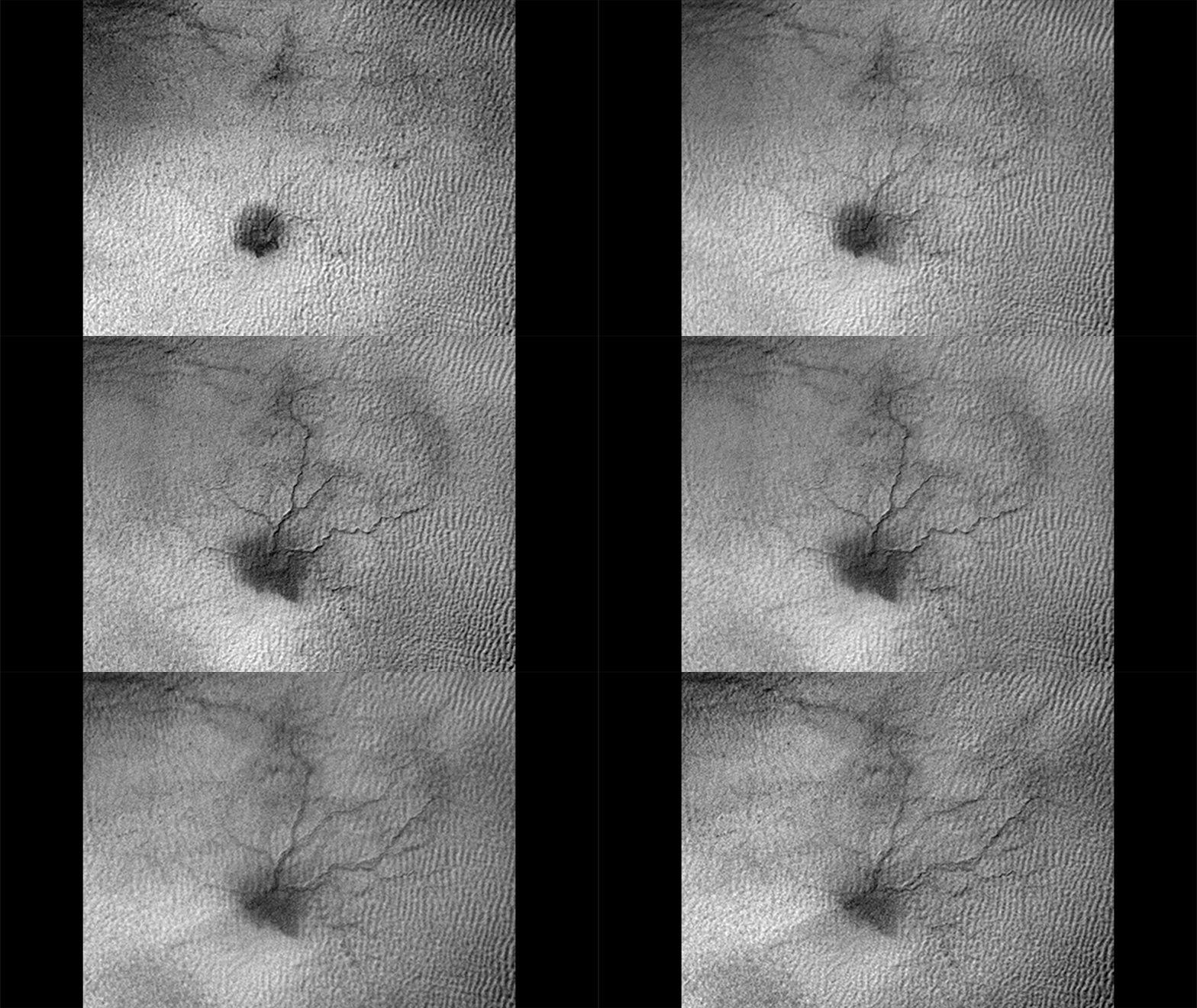
Bildkälla; NASA/MRO/HiRISE
* Bilderna ovan är 195 m tvärsöver och vi befinner oss på latituden 70 gr syd på Mars.
* Bilderna är från 2009, 2011 och 2015.
* En teori pratar om att solvärmen tränger igenom lagren av koldioxid ner genom ytan, där isen förvandlas till gas, som expanderar och spränger sig upp och bildar ett hål i isen ovanför. Annan gas följer med upp och tar med sig sand och andra partiklar upp i atmosfären, som så småningom genom Marsvinden lägger sig i den märkkliga fjäderformen.
* Storlekarna kan röra sig om allt från 10-tals till 100-tals meter, och nu har Mars-forskarna också kunnat se hur processen går till med några års mellanrum. Mars Reconnaissance Orbiter aka MRO och dess kamerasystem kallat High Resolution Imaging Science Experiment (HiRISE) har fångat dramat.
' Här finns också en koppling till Mars sanddyner.
* Ytterligare bilddokument från HiRISE visar på det unika geologiska fenomenet, som bara Mars har (vad vi vet):
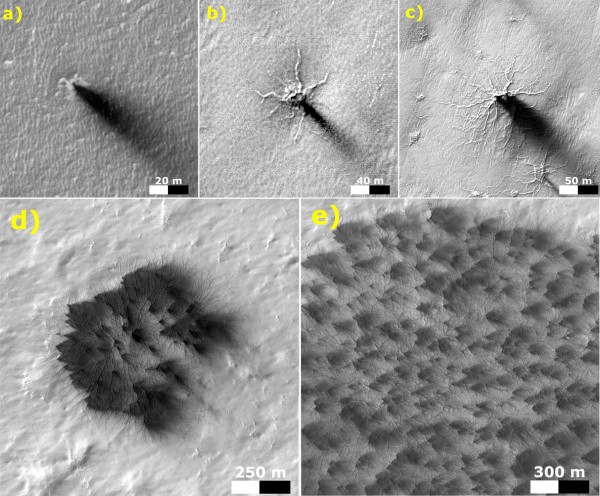
Bildkälla: NASA/JPL-Caltech/Univ. of Arizona
Berlinbok tipsar om Wilhelm-Foerster-Sternwarte
Berlin förekommer ofta i mina tankar, och senaste tidens händelser behöver jag inte kommentera. Noterar att vännen Trygve Bång i höst kommit med en förnämlig Berlin-guide, Berlin: Upptäcktsfärder i tid och rum (ARX Förlag).
Boken bjuder på kort saklig info om det mesta av det bästa, och kul nog förekommer även Wilhelm-Foerster-Sternwarte i boken som ett lämpligt utflyktsmål. Jag hade mycket med detta inspirerande folkobservatorium och dess chef att göra på 60-talet, och en nyårshelg, då jag och Bertil Pettersson (så småningom astronom i Uppsala) bodde hos goda Berlin-vänner för att fira en riktig och grundlig berlinsk Sylvester, var vi på plats och dokumenterade uppförandet av det fina planetariumet vid observatoriet.
Detta planetarium kunde 50-årsjubilera i fjor…
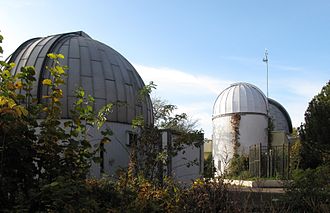
Flera kupoler ingår i observatoriets arsenal liksom ett klassiskt Zeiss-planetarium. Bildkälla: WFS
Kolstoft runt Nova Del 2013
Novan i Delphini/Delfinen 2013, katalogbetecknad som V339 Delhini, kunde lätt ses för blotta ögat och i en fältkikare. Novan har sen upptäckten följts noga av astronomer, bl a via SOFIA, det flygande infrarödkänsliga teleskopet, varav några nu rapporterar om det kolrika stoftet (grafit) i skalet runt stjärnsmällen.
(Phys.org)—A team of astronomers led by Aneurin Evans of the Keele University, U.K., has observed the classical nova V339 Delphini (V339 Del for short) and spotted some peculiar changes in its dust shell. These observations could improve our knowledge about dust formation around stellar remnants. The results of the observational campaign are presented in a paper published Dec. 19 on the arXiv pre-print repository.
Discovered in August 2013, V339 Delphini is a bright nova in the constellation Delphinus. It is the first nova that has been observed to synthesize lithium, providing the first direct evidence of the supply of lithium to the interstellar medium by an astronomical object. Interestingly, follow-up observations after the discovery of V339 Delphini showed that one month after its detection, dust formation commenced in this nova.
To better understand the dust formation process in V339 Delphini, Evans and his colleagues have analyzed sets of data provided by the Stratospheric Observatory For Infrared Astronomy (SOFIA), the Mt. Abu Infrared Observatory in India, the O'Brien Observatory in Marine on St Croix, Minnesota, NASA's Infrared Telescope Facility (IRTF), Hawaii, and the Multiple Mirror Telescope (MMT), located on Mt. Hopkins, Arizona.
The data collected from over two years of observations allowed the researchers to distinguish an apparent rise and decline of the mass and radius of dust grains around this stellar remnant.
The team noted that the rapid dust formation occurs around 34th day of observations and afterward, the infrared emission became dominated by the dust. They also found that the dust is graphitic and its condensation temperature was 1,480 K at that moment.
According to the paper, the dust shell that formed had a mass of about five billionths of the mass of the sun and the grains grew to a dimension of a few micrometers. Next, the size and mass of the grains increased rapidly (while the temperature dropped to about 1,000 K), peaked around 100 days after eruption, and finally declined precipitously after this peak.
"The mass of dust initially rose as a result of an increase in grain size and/or number, peaked at about day 100, and then declined precipitously," the paper reads.
The researchers sought the most plausible explanation for the observed rise and fall of V339 Delphini's dust shell. According to them, this change is most likely caused by charging of dust grains by the X-ray emission.
"We attribute this to the charging of dust grains by the X-ray emission of V339 Del, causing the grains to shatter due to electrostatic stress," the astronomers concluded.
Moreover, the authors of the paper excluded the possibility that the destruction of dust grains could be due to evaporation as the temperature was too low to evaporate these graphitic grains.
"When the dust mass peaked around day 100, the dust temperature was about 1,000 K and steadily declined thereafter; it seems unlikely, therefore, that below 1,000 K, graphitic grains—for which the sublimation temperature is more than 1,800 K for carbon-rich environments— would be subject to evaporation," the scientists wrote in the paper.
 Explore further: Scientists catalog nearly 100 dusty globules in the Crab Nebula
More information: Rise and fall of the dust shell of the classical nova V339 Delphini, arXiv:1612.06241 [astro-ph.SR] arxiv.org/abs/1612.06241
Abstract
We present infrared spectroscopy of the classical nova V339 Delphini, obtained over a ∼2 year period. The infrared emission lines were initially symmetrical, with HWHM velocities of 525 km s−1. In later (t≳77days, where t is the time from outburst) spectra however, the lines displayed a distinct asymmetry, with a much stronger blue wing, possibly due to obscuration of the receding component by dust. Dust formation commenced at ∼ day 34.75 at a condensation temperature of 1480±20K, consistent with graphitic carbon. Thereafter the dust temperature declined with time as Td∝t−0.346, also consistent with graphitic carbon. The mass of dust initally rose, as a result of an increase in grain size and/or number, peaked at ∼ day 100, and then declined precipitously. This decline was most likely caused by grain shattering due to electrostatic stress after the dust was exposed to X-radiation. An Appendix summarises Planck Means for carbon, and the determination of grain mass and radius for a carbon dust shell.
Read more at: http://phys.org/news/2016-12-astronomers-fall-shell-nova-v339.html#jCp
Discovered in August 2013, V339 Delphini is a bright nova in the constellation Delphinus. It is the first nova that has been observed to synthesize lithium, providing the first direct evidence of the supply of lithium to the interstellar medium by an astronomical object. Interestingly, follow-up observations after the discovery of V339 Delphini showed that one month after its detection, dust formation commenced in this nova.
To better understand the dust formation process in V339 Delphini, Evans and his colleagues have analyzed sets of data provided by the Stratospheric Observatory For Infrared Astronomy (SOFIA), the Mt. Abu Infrared Observatory in India, the O'Brien Observatory in Marine on St Croix, Minnesota, NASA's Infrared Telescope Facility (IRTF), Hawaii, and the Multiple Mirror Telescope (MMT), located on Mt. Hopkins, Arizona.
The data collected from over two years of observations allowed the researchers to distinguish an apparent rise and decline of the mass and radius of dust grains around this stellar remnant.
The team noted that the rapid dust formation occurs around 34th day of observations and afterward, the infrared emission became dominated by the dust. They also found that the dust is graphitic and its condensation temperature was 1,480 K at that moment.
According to the paper, the dust shell that formed had a mass of about five billionths of the mass of the sun and the grains grew to a dimension of a few micrometers. Next, the size and mass of the grains increased rapidly (while the temperature dropped to about 1,000 K), peaked around 100 days after eruption, and finally declined precipitously after this peak.
"The mass of dust initially rose as a result of an increase in grain size and/or number, peaked at about day 100, and then declined precipitously," the paper reads.
The researchers sought the most plausible explanation for the observed rise and fall of V339 Delphini's dust shell. According to them, this change is most likely caused by charging of dust grains by the X-ray emission.
"We attribute this to the charging of dust grains by the X-ray emission of V339 Del, causing the grains to shatter due to electrostatic stress," the astronomers concluded.
Moreover, the authors of the paper excluded the possibility that the destruction of dust grains could be due to evaporation as the temperature was too low to evaporate these graphitic grains.
"When the dust mass peaked around day 100, the dust temperature was about 1,000 K and steadily declined thereafter; it seems unlikely, therefore, that below 1,000 K, graphitic grains—for which the sublimation temperature is more than 1,800 K for carbon-rich environments— would be subject to evaporation," the scientists wrote in the paper.
Explore further: Scientists catalog nearly 100 dusty globules in the Crab Nebula
More information: Rise and fall of the dust shell of the classical nova V339 Delphini, arXiv:1612.06241 [astro-ph.SR] arxiv.org/abs/1612.06241
Abstract
We present infrared spectroscopy of the classical nova V339 Delphini, obtained over a ∼2 year period. The infrared emission lines were initially symmetrical, with HWHM velocities of 525 km s−1. In later (t≳77days, where t is the time from outburst) spectra however, the lines displayed a distinct asymmetry, with a much stronger blue wing, possibly due to obscuration of the receding component by dust. Dust formation commenced at ∼ day 34.75 at a condensation temperature of 1480±20K, consistent with graphitic carbon. Thereafter the dust temperature declined with time as Td∝t−0.346, also consistent with graphitic carbon. The mass of dust initally rose, as a result of an increase in grain size and/or number, peaked at ∼ day 100, and then declined precipitously. This decline was most likely caused by grain shattering due to electrostatic stress after the dust was exposed to X-radiation. An Appendix summarises Planck Means for carbon, and the determination of grain mass and radius for a carbon dust shell.
Read more at: http://phys.org/news/2016-12-astronomers-fall-shell-nova-v339.html#jCp
Discovered in August 2013, V339 Delphini is a bright nova in the constellation Delphinus. It is the first nova that has been observed to synthesize lithium, providing the first direct evidence of the supply of lithium to the interstellar medium by an astronomical object. Interestingly, follow-up observations after the discovery of V339 Delphini showed that one month after its detection, dust formation commenced in this nova.
To better understand the dust formation process in V339 Delphini, Evans and his colleagues have analyzed sets of data provided by the Stratospheric Observatory For Infrared Astronomy (SOFIA), the Mt. Abu Infrared Observatory in India, the O'Brien Observatory in Marine on St Croix, Minnesota, NASA's Infrared Telescope Facility (IRTF), Hawaii, and the Multiple Mirror Telescope (MMT), located on Mt. Hopkins, Arizona.
The data collected from over two years of observations allowed the researchers to distinguish an apparent rise and decline of the mass and radius of dust grains around this stellar remnant.
The team noted that the rapid dust formation occurs around 34th day of observations and afterward, the infrared emission became dominated by the dust. They also found that the dust is graphitic and its condensation temperature was 1,480 K at that moment.
According to the paper, the dust shell that formed had a mass of about five billionths of the mass of the sun and the grains grew to a dimension of a few micrometers. Next, the size and mass of the grains increased rapidly (while the temperature dropped to about 1,000 K), peaked around 100 days after eruption, and finally declined precipitously after this peak.
"The mass of dust initially rose as a result of an increase in grain size and/or number, peaked at about day 100, and then declined precipitously," the paper reads.
The researchers sought the most plausible explanation for the observed rise and fall of V339 Delphini's dust shell. According to them, this change is most likely caused by charging of dust grains by the X-ray emission.
"We attribute this to the charging of dust grains by the X-ray emission of V339 Del, causing the grains to shatter due to electrostatic stress," the astronomers concluded.
Moreover, the authors of the paper excluded the possibility that the destruction of dust grains could be due to evaporation as the temperature was too low to evaporate these graphitic grains.
"When the dust mass peaked around day 100, the dust temperature was about 1,000 K and steadily declined thereafter; it seems unlikely, therefore, that below 1,000 K, graphitic grains—for which the sublimation temperature is more than 1,800 K for carbon-rich environments— would be subject to evaporation," the scientists wrote in the paper.
Explore further: Scientists catalog nearly 100 dusty globules in the Crab Nebula
More information: Rise and fall of the dust shell of the classical nova V339 Delphini, arXiv:1612.06241 [astro-ph.SR] arxiv.org/abs/1612.06241
Abstract
We present infrared spectroscopy of the classical nova V339 Delphini, obtained over a ∼2 year period. The infrared emission lines were initially symmetrical, with HWHM velocities of 525 km s−1. In later (t≳77days, where t is the time from outburst) spectra however, the lines displayed a distinct asymmetry, with a much stronger blue wing, possibly due to obscuration of the receding component by dust. Dust formation commenced at ∼ day 34.75 at a condensation temperature of 1480±20K, consistent with graphitic carbon. Thereafter the dust temperature declined with time as Td∝t−0.346, also consistent with graphitic carbon. The mass of dust initally rose, as a result of an increase in grain size and/or number, peaked at ∼ day 100, and then declined precipitously. This decline was most likely caused by grain shattering due to electrostatic stress after the dust was exposed to X-radiation. An Appendix summarises Planck Means for carbon, and the determination of grain mass and radius for a carbon dust shell.
Read more at: http://phys.org/news/2016-12-astronomers-fall-shell-nova-v339.html#jCp
Vad hände 2016?
Det börjar bli dags att summera det astronomiska året 2016. Alla är överens om att högst på pallen kommer den defitiva upptäckten av gravitationsvågor. LIGO-teoretikerna lär ligga bra till för Nobelpriset i fysik 2017.
Så skapades "badankan"
Hur gick det till då "Rosetta-kometen" aka 67P/Churyumov-Gerasimenko (67P) bildades och fick sin form a la en badanka? W-bloggen har tidigare synat hur de schweiziska astronomer och räknat på förloppet, som kan tänkas ha sett ut som nedan. Den illustrationen hade vi inte med förra gången, så här är den nu:
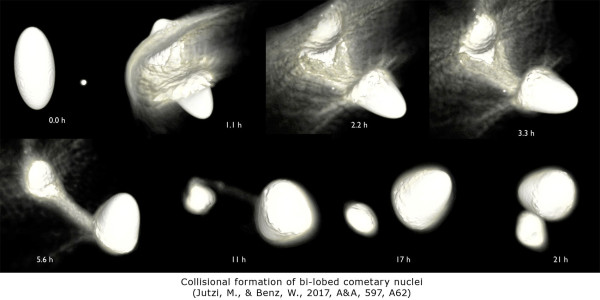
Rapporten "Formation of bi-lobed shapes by sub-catastrophic collisions: A late origin of comet 67P’s structure" har fokus på vad astronomerna beskriver som en low energy, sub-catastrophic impact. Håller sig kollisionen inom vissa gränser, överlever bägge delarna utan att smulas itu av smällen.

Tack för alla julkort
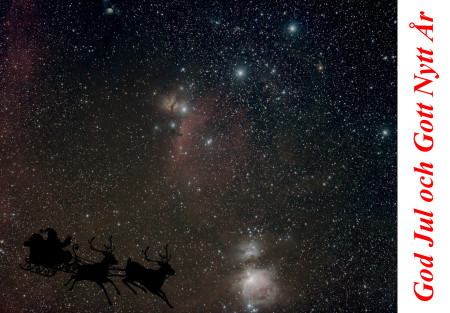
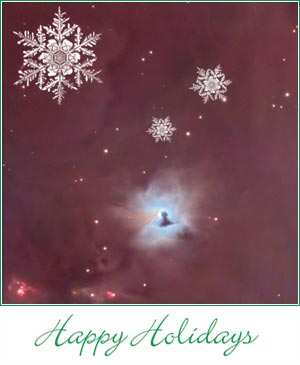
Tack till alla astronomivänner, som mailat eller skickat julkort via snailmail. Några stack ut i skörden av hälsningar.
Ett mycket trevligt hemmastampat julkort kom t ex från Håkan Barregård:
ESO passade på att önska god jul så här:
 Från en kompis på amerikanska NRAO kom denna hälsning:
 NASA-astronauten Peggy Whitson twittrade över denna bild till jorden, en selfie på en viktlös tomte ombord på ISS:
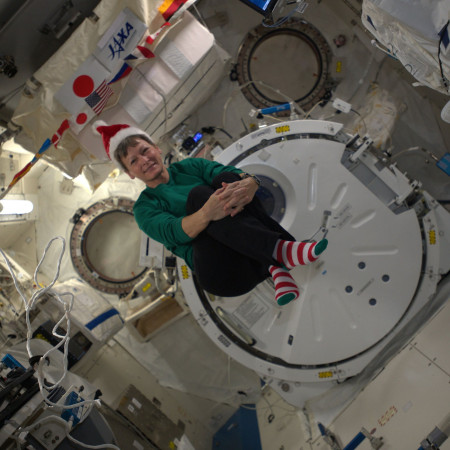
Bildkälla: NASA/Peggy Whitson via Twitter
I Lomma driver gamle KvP:aren Calle Rockbäck sin egen underhållande blogg, och i den knyter han då och då till vad som skrivs i W-bloggen. God fortsättning, Calle!

Vår fina animation på ASTB:s egen hemsida inte att förglömma!