Ny dvärgplanet upptäckt:
Vera Rubin-teleskopet levererar redan
I går (27.10) meddelade Vera Ruben-ansvariga den första större upptäckten – en sannolik dvärgplanet på ett avstånd av 46 astronomiska enheter ut i den kalla postneptuniska rymden. Jag kör pressrelisen från observatoriet på engelska. Be my guest!
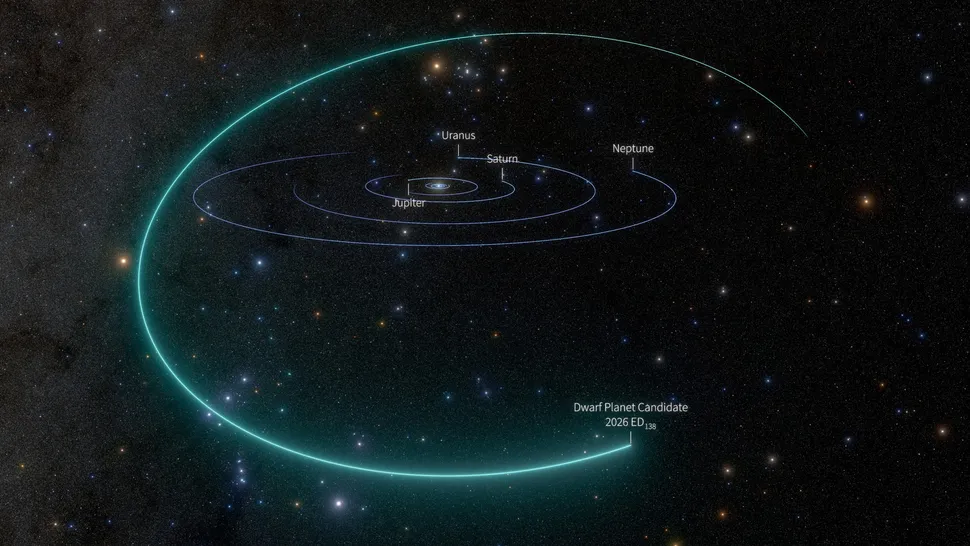
In the outer reaches of our Solar System, beyond the orbit of Pluto, NSF–DOE Vera C. Rubin Observatory has spotted 2026 ED138 — a large, bright trans-Neptunian object that scientists have identified as a dwarf planet candidate. The observations were announced today by the International Astronomical Union Minor Planet Center (MPC). If confirmed, ED138 would be among the largest dwarf planets ever discovered in this region of the Solar System.
With observations taken during the run up to the Legacy Survey of Space and Time (LSST), NSF–DOE Vera C. Rubin Observatory has discovered a new dwarf planet candidate in our Solar System. The candidate, which has been given the provisional designation 2026 ED138 (ED138), was found by Rubin Operations team member and in-Kind contributor Matthew Holman (Center for Astrophysics | Harvard & Smithsonian [CfA]). He contributes to improving Rubin’s algorithms that search for distant moving objects in our Solar System. The candidate’s distance from the Sun places it beyond the orbit of dwarf planet Pluto. Initial analysis indicates that it may be among the largest and brightest bodies scientists have discovered in this region of the Solar System.
Rubin Observatory is jointly funded by the U.S. National Science Foundation and the U.S. Department of Energy’s Office of Science.
“Rubin Observatory’s super power is the ability to clearly capture movement and change among a vast number of objects and phenomena that humans have never seen before,” says Edward Ajhar, NSF Program Director for Rubin Observatory. “That power greatly extends our ability to reveal and understand new things about our Solar System, the Milky Way, and billions of other galaxies across the Universe.”
“Rubin Observatory’s unique strengths make it an incredible tool for investigating a wide range of astrophysical phenomena, from dark energy to the discovery of this dwarf planet candidate,” says Kathy Turner, DOE’s Program Manager for Rubin Observatory.
Today, MPC announced the discovery in a Minor Planet Electronic Circular. Mario Jurić, faculty at the University of Washington and Rubin Solar System Lead Scientist, and Holman presented the results at a press conference at the 58th Annual Division for Planetary Sciences (DPS) meeting in Spokane, Washington.
On the evening of 13 October, Holman was running data collected by Rubin earlier in 2026 through a search code he developed with CfA colleague Kevin Napier. The code is built to look at billions of detections of moving objects, compare them, and find the detections that correspond to the same object. Using this method, Holman uncovered ED138, and he immediately noticed that its brightness and distance indicated that it is unusually large.
“My first reaction was one of excited disbelief,” says Holman. “Objects like this are very rare, so I immediately started checking whether I or the code had done something wrong.”
To remove any doubt, a detailed search through the data began in the hopes of uncovering more observations of ED138. Jurić searched Rubin’s catalogs and images and found 20 more observations, going back to 4 March 2026. In all, Rubin’s Simonyi Survey Telescope observed ED138 30 times on 20 nights between 4 March and 11 July. Additional archival images from the DOE-fabricated Dark Energy Camera (DECam), and uncovered by the Asteroid Institute’s ADAM Precovery service, provided data going all the way back to 2016. These data allowed the team to trace more than 10 years of ED138’s orbit. DECam is mounted on the NSF Victor M. Blanco 4-meter Telescope at Cerro Tololo Inter-American Observatory (CTIO), a Program of NSF NOIRLab.
ED138 is currently at a distance of about 46 astronomical units (au), where 1 au is the average distance between the Earth and the Sun. For reference, dwarf planet Pluto has an average distance of 40 au. This classifies ED138 as a trans-Neptunian object (TNO) — objects that orbit the Sun at a distance greater than Neptune’s.
A model of the Solar System showing the orbital pathway of newly discovered dwarf planet candidate 2026 ED138 (ED138). ED138 was discovered in observational data from NSF–DOE Vera C. Rubin Observatory spanning 4 March–11 July 2026. The rendering starts on 8 May 2026. Visit Orbitviewer to interact with ED138’s orbit in 3D and in real-time. Credit: NSF–DOE Vera C. Rubin Observatory/NOIRLab/SLAC/AURA/R. Proctor.
Scientists study the size, composition, and orbital trajectories of TNOs to understand how the Solar System formed, how the giant planets migrated over time, and how smaller objects have been scattered throughout this evolution. ED138’s orbit is tilted almost 25 degrees off of the plane of the Solar System, classifying it as a hot-classical TNO and suggesting that it was disturbed from its original orbit through gravitational interactions with Neptune.
Not all TNOs are considered dwarf planet candidates, with the distinction being in the size and shape of the object. To be a dwarf planet an object needs to be massive enough for its own gravity to pull it into a round shape. Based on ED138’s distance, brightness and estimated surface reflectivity (albedo), the team estimates that its size is between 600 and 1500 kilometers, and icy bodies this large are expected to be round.
This preliminary analysis places ED138 among the largest dwarf planet candidates ever discovered beyond Neptune, though observations in the infrared are needed to constrain its exact size and confirm its nature as a dwarf planet. If confirmed, ED138 would join the five dwarf planets recognized by the International Astronomical Union (IAU): Pluto, Ceres, Eris, Haumea, and Makemake.
ED138 was found in a region of sky close to the plane of the Milky Way — a crowded region filled with millions of stars. To most telescopes, ED138 has been lost among the myriad background sources, which is likely why it was not discovered until now. Rubin Observatory’s regular and continuous monitoring of the entire Southern Hemisphere sky, combined with powerful algorithms that sift through millions to billions of points of light to identify those corresponding to small moving objects, enabled the team to spot ED138 within the crowded field.
“Rubin is giving us an unprecedented capacity to explore the sky through a combination of speed, depth, and precision,” says Jurić. “And the discovery is just the beginning: once we identify a new object, we can search back months, and sometimes even decades, finding it in images where nobody knew to look. This ability to both discover and ‘precover’ objects is transforming how quickly and accurately we can determine their orbits and understand the distant Solar System.”
ED138 joins the rapidly growing sample of Solar System objects discovered by Rubin since it began collecting early data in preparation for the LSST, which began in June 2026. In April, before LSST formally began, the Rubin Solar System team submitted observations of over 11,000 new asteroids to the IAU Minor Planet Center (MPC), which included roughly 380 new TNOs. At the time, the team called this large submission “the tip of the iceberg” and expressed their excitement for the discoveries to come once LSST began. With the discovery of ED138, those hopes are coming to fruition.
“If confirmed as a dwarf planet, ED138 would join a very small family of worlds,” says Holman. “Rubin will image the whole southern sky again and again for ten years, so any others hiding in the places earlier surveys skipped are now within reach.”
Now that Rubin has identified ED138, scientists around the globe can organize follow-up observations to uncover even more information about its nature. Images of ED138 are made available to Rubin data rights holders on the Rubin Science Platform, an online, web-based environment where scientists can access, explore, and process the massive amounts of data being produced by the LSST. The public can also interact with this discovery on Orbitviewer, an interactive web-based app that provides an intuitive way to explore the structure of our cosmic backyard in three dimensions and in real time.